Bård Eithun
Lords of ChaosBård Eithun, known in the Norwegian Black Metal scene as Faust, was a drummer, fanzine editor, and participant in the circle around Mayhem and the Helvete record shop. His passage from musical enthusiasm into the scene’s criminal history was stark: in August 1992 he murdered Magne Andreassen, and he later received a fourteen-year sentence. His own recollections, alongside the book’s account of the scene, also make him a witness to the ways music, notoriety, and the pursuit of an extreme identity converged without making them a single, simple cause.
Identity and Entry into the Scene
Eithun was an experienced drummer and played in Stigma Diabolicum, Thorns, and Emperor. The book identifies him as one of the important figures who, alongside Øystein Aarseth and Varg Vikernes, helped leave a violent imprint on the Norwegian scene. He also worked beyond the stage: in the early 1990s he published Orcustus, a fanzine that corresponded with and interviewed people of importance in Norwegian Black Metal. His position combined musical participation with a sustained interest in documenting the scene from within.
Mayhem first reached him as a legend that was more widely known than heard. Its demos and mini-album had circulated in limited quantities, and Eithun recalled being excited by the prospect of hearing the band. Because he knew the vocalist Maniac, he obtained an extra copy of the mini-album. He found the music more violent and brutal than anything he had heard before. The members’ scarce interviews, long hair, and faces obscured in photographs made them seem mysterious to him; the image and the music arrived together, each intensifying the other.
When Eithun met the members, their appearance and reserved manner accorded with his expectations. Conversation was largely about records and practical matters, though he remembered them as nice to him. He attended Mayhem’s first official gig in 1990, one of the band’s rare public performances. He later recalled that Dead deliberately injured himself during the show and was in pain afterward. The recollection sits beside a larger contrast in the book: Mayhem’s public image depended on exceptional, theatrical performances, while the band’s infrequent opportunities to play helped make those appearances seem all the more charged.
Work at Helvete and the Scene’s Escalation
Eithun began working at the Helvete record shop in July 1992 and stayed until July 1993. Euronymous had opened the shop in May or June 1991 and, after an earlier arrangement with two other men failed, asked Eithun to work there. The Labor Exchange system made it possible for Eithun to receive money while the shop had someone working in it. He described the job as interesting, placing him in a daily setting where records, scene participants, and the shop’s social life met.
In his reflections on the scene, Eithun distinguished sincere ideological commitment from the desire for attention. He believed some participants were drawn to Black Metal’s opposition to Christianity and organized religion, while others were glad of the attention and then sought to go further. This distinction matters to his account: notoriety could reward escalation, but he did not present every participant as sharing the same convictions or motives.
The book places Eithun’s crime amid an atmosphere of increasingly extreme conduct, including the first Norwegian church burnings. It describes his longstanding fascination with murder and violence as part of the context, not as proof of a single cause. Ihsahn, Eithun’s former bandmate in Emperor, later suggested that Eithun had wanted to know what killing another person was like. That is Ihsahn’s interpretation; Eithun’s own account of the killing emphasizes his limited recollection and the decisive choice he made once the encounter had begun.
Murder of Magne Andreassen and Sentence
On August 21, 1992, Eithun was visiting his family in Lillehammer, having moved to Oslo the previous month. He went out late, stopped at a pub, found the atmosphere did not suit him, and headed back through a nearby park. He carried a knife, which he had described as a precaution while living in Oslo rather than as a weapon intended for a particular target. The account states that he was not intoxicated or under the influence of drugs when he encountered Andreassen.
Eithun later said he could not clearly remember what he was thinking, but knew that if he did not act then he might not get another opportunity. He described turning toward Andreassen and attacking him. His recollection then became fragmented: he experienced the incident as if watching two people from outside himself. He also said that he intended to ensure Andreassen would not survive and report him. These details do not resolve the deeper motive; they establish the deliberate violence of the act and the effort to prevent its discovery.
The police investigation initially reached a dead end. The book describes a body found in the woods and little significant evidence, while investigators pursued leads in the gay community. Eithun said that at first he expected to be arrested, but as months passed without an arrest he began to think the police might not be interested and that he could escape consequences. In retrospect, the apparent impunity was temporary, but it formed part of the sequence in which the scene’s criminal acts continued.
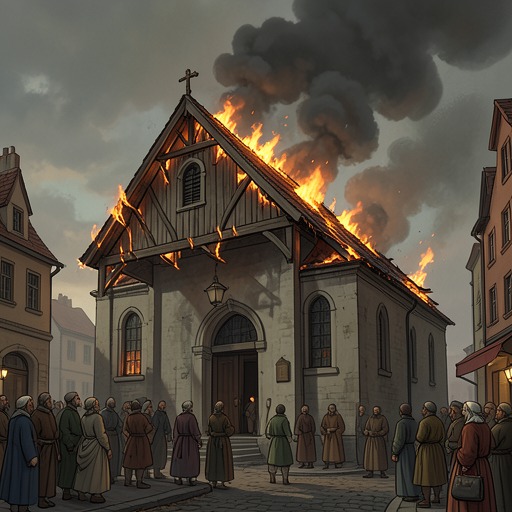
The day after the murder, Eithun took part with Vikernes and Aarseth in the burning of Holmenkollen Chapel. The book recounts that the three watched the fire before returning to the record shop. Eithun later received a fourteen-year sentence for murder. His punishment was shorter than Vikernes’s twenty-one-year sentence and longer than the sentences given to several others involved in church burnings. The differing penalties reflect the distinct offenses for which the participants were sentenced; they also mark the point at which the scene’s escalating actions became matters of criminal judgment rather than rumor and image.
Image, Rumor, and Media Attention
Eithun’s recollections of Dead and Aarseth show how Mayhem’s reputation was shaped not only by performance but by stories told afterward. Asked whether Dead had killed himself, Eithun confirmed that he had. He recalled Aarseth telling him that the rumor that Aarseth might have been responsible could be allowed to persist because it would generate further rumors about Mayhem. Eithun also said Aarseth did not clarify publicly what he had done with material from Dead’s remains, leaving listeners to construct their own image of the band’s supposed extremity. In this account, obscurity was not merely an accidental consequence of silence: it could be cultivated as part of the group’s public identity.
Eithun likewise connected press coverage with the scene’s appetite for attention. He remembered that after a Kerrang! feature appeared, the others became enthusiastic because it brought them notice. He also agreed that publicity helped draw young people into the scene in Norway after the arrests, and said many later church burnings were committed by young people who became involved afterward. His account presents media attention as an accelerant and a source of status, rather than as the sole origin of the crimes.
His later comments were not a claim that all Satanism in the scene had the same seriousness. Eithun said that it mattered deeply to a few people but was largely hype for many others, including himself. He had been interested in Satanism and once contacted the Ordo Templi Orientis to learn about it, but found its approach too obscure for him. He also recalled that sensational newspaper stories about secret cults and sacrifices in the late 1980s could create an atmosphere of mystery and encourage people to want to become the subjects of such coverage. His remarks reveal an ambivalence: he recognized how publicity could manufacture fascination even as he described participating in a scene that benefited from it.
Later Perspective and Narrative Significance
Eithun described his continuing connection as belonging to the underground scene that existed while he was free, not to the scene that developed later. That distinction separates personal memory from ongoing membership: his identity remained tied to an earlier network, while the music and its audience continued to change. The book’s portrayal of him therefore moves between participant and retrospective witness, without treating the later commentary as erasing his role in the violence.
He also interpreted the growing connection between Black Metal and the extreme right as part of a wider search for cultural inheritance. In his view, people became more conscious of their past and country, and sought ways to celebrate heritage; he saw the growth of politically extreme bands as moving quickly alongside the early-1990s growth of Black Metal. This was his explanation of a trend, not evidence that all musicians or fans held the same politics.
Eithun’s significance in the account rests on this combination of positions. He was a musician who had been drawn to Mayhem’s rare, forbidding image; a fanzine editor and record-shop worker embedded in the scene; a convicted murderer whose actions intersected with the church arson wave; and a later commentator on the feedback between publicity and transgression. The narrative places his crime within a culture that could turn attention into status, but keeps the act and its consequence distinct: the scene’s mythology did not make him less responsible, and the retrospective explanations do not undo the sentence he received.